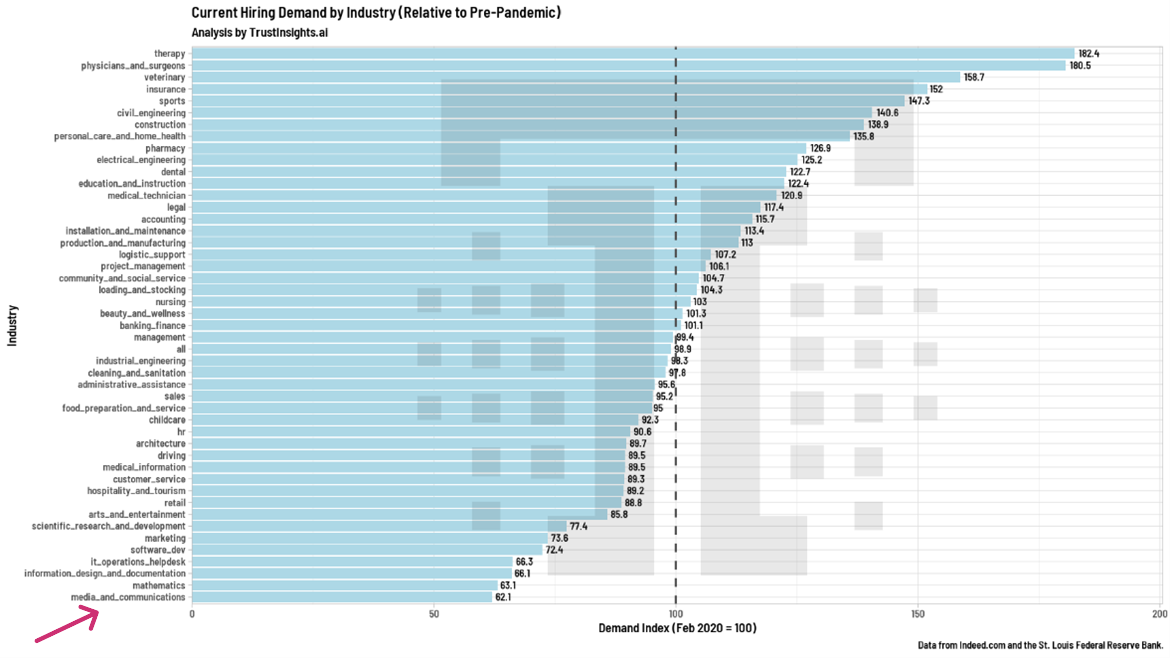
Media and communications is now the least in‑demand industry in the United States.
Indeed’s April snapshot, surfaced in Christopher Penn’s Almost Timely newsletter, puts our field at the bottom of the table, with marketing sixth from the bottom and hiring demand for both more than 30% below February 2020 levels.
Penn went further: he ran a director of product marketing job description through Trust Insights’ TRIPS framework and found 90% of the role can be reshaped by AI today; an account coordinator role at a PR firm came back at 82% consumable outright.
If AI can substitute or accelerate 80–90% of what we have told boards our function is “for”, then this is not a technology shock. It is the price being paid for how we chose to define and justify our work.
The production identity problem
Elif Güvençer’s recent paper, The Two Clocks: A Framework for Communications in the Age of AI, calls this our “production identity”: a value proposition built on outputs. The release. The deck. The activity report. The tier‑one business profile. The reality is that the communications function was never just production. Our real contribution was always upstream: interpretation, risk sense‑making, pacing leadership through a crisis rather than amplifying it, reading cultural shifts before stakeholders felt them.
However, upstream work is hard to label and harder to measure. So, we sold what was easy to count. A generation of comms leaders walked into boardrooms with KPIs that flattered activity and concealed worth. A generation of consultancies found it easier to take the brief than to challenge it. We built an industry around the proxy and let the actual value go unclaimed.
AI has taken us at our word. If you define your function as an output factory, you do not get to act surprised when the factory is automated.
Two clocks, one job
Güvençer’s central claim is that two clocks are running simultaneously, and most communications functions only manage one.
The “immediate clock” is outward‑facing: AI‑mediated monitoring, synthetic reputation, new governance surfaces. It is legitimate, urgent, and will absorb every hour the function has, including the hours AI hands back through automation.
The “structural clock” is inward‑facing. It asks what communications needs to become, how it is positioned, what it is measured on, and which capabilities it keeps or kills. It has no external deadline. Nobody is scheduling that board conversation. It will not happen unless someone makes it happen.
Run only the immediate clock and you become busier on shrinking territory. Run only the structural clock and you optimise for a world moving past you. Do both, or neither works.
Trust as a commercial asset
Güvençer argues that communications has a non‑substitutable role in AI governance because its object is coherence: the total picture, not the individual tactics. I agree. The reason that matters, however, is commercial, not just reputational, and this is where communications can finally demonstrate its long‑sought business value‑add.
When a buyer asks an AI assistant which vendors to consider and gets three names, the firms that do not make the cut do not only lose reputation. They lose revenue. The signal architecture Güvençer describes – the coherence of what AI systems read about you across earned and owned surfaces – is a pipeline mechanism as much as a reputational one. Trust is what gets you onto the shortlist. Trust is what gets you through it. Trust is the asset that decides whether the meeting happens at all.
Our industry has spent a long time talking about trust as if it were a sentiment score. It is more than that. It is the complex variable that decides whether commercial outcomes happen or do not, and reputation is the durable form it takes over time.
The function best positioned to govern that asset is the one most at risk of being treated as overhead. That is the strategic absurdity at the heart of the Indeed numbers. Whoever governs the signal is, by definition, acting as a commercial leader.
If comms does not claim that role, someone else will.
Five moves, one direction
I recently considered this existential problem from the “less talk, more action” point of view and outlined five operational moves a communications team can make this quarter to show up in a world where buyers are asking AI assistants who to consider.
- Earned‑first mindset. Stop treating earned as clips. Start treating it as strategic training data for AI shortlists, given most citations in generative answers come from non‑paid third‑party sources.
- Benchmark AI answers. Run a quarterly AI share‑of‑voice across ChatGPT, Gemini, Perplexity and Copilot on the questions your buyers actually ask. Track where and how you appear.
- Machine‑readable credibility. Sharpen about pages, bios and customer cases so models can lift a precise, consistent explanation of who you are, and make sure it exists in the places they trust.
- Prioritise LinkedIn. Treat it as front‑row input to generative search, not a side project. Your leaders’ presence is distribution infrastructure now, not a vanity exercise.
- Assign ownership and protect experiments. Make generative visibility someone’s job with a 90‑day mandate and ring‑fenced time and budget, not “something we are keeping an eye on”.
The two pieces of work are the same project from opposite ends.
Güvençer’s structural clock asks what the function is for. The five moves are the first steps – reflecting both the immediate and structural clocks – to ensure the communications function shows up where reputation and revenue are now mediated.
Bottom line: you cannot credibly claim a seat at the AI governance table while still being measured on press releases. And you cannot redesign the function’s identity if you have no operational footprint in the channels that now decide who gets shortlisted.
The courage gap
BCG, cited in Güvençer’s paper, says 88% of corporate affairs and comms leaders do not feel prepared to lead an AI transformation in their function. That reads less like a skills problem and more like a courage gap.
GlobeScan’s most recent annual corporate affairs survey with Oxford Saïd Business School tells a similar story. Ninety‑two per cent of Asia‑Pacific corporate affairs leaders say the function needs to change, eighteen points ahead of the global average. Around a third want clearer strategy and focus; a quarter flag impact measurement, data and AI capabilities as the priority gaps. The appetite for reinvention is loud. The follow‑through is what looks uncertain.
Experienced communications professionals have known for years that output was not the whole sum of their parts. The real work was always upstream, but we have been timid in claiming this. We have also known the brief was sometimes wrong. We just would not necessarily say it – to clients, to boards, or to ourselves – because it was too hard and easier to go the vanity metrics route. As a result, the technology has not caused the demotion. The unwillingness to have the harder conversation did.
Courage here is being prepared to turn down pure‑output retainers. It is rewriting the scorecard, so trust and visibility show up as commercial drivers alongside reputation. And it is convening the AI governance conversation rather than waiting to be invited.
If we do not do this, the demotion will arrive through a series of reasonable‑looking decisions that you are not privy to. The AI committee that meets without you. The GEO plan written by marketing and sent over “for your awareness”. The leader who drafts their own AI‑assisted quote and asks you to tidy it up. All of it reshapes and shrinks the communications mandate, one missed invitation at a time.
The Indeed data is not AI’s verdict on communications. It is the price being paid for decades of treating output as the value and leaving the upstream contribution unclaimed. The machines will keep doing their part. Now the real question to be answered is whether communicators will step up and seize the commercial mandate while there is still time to do so.