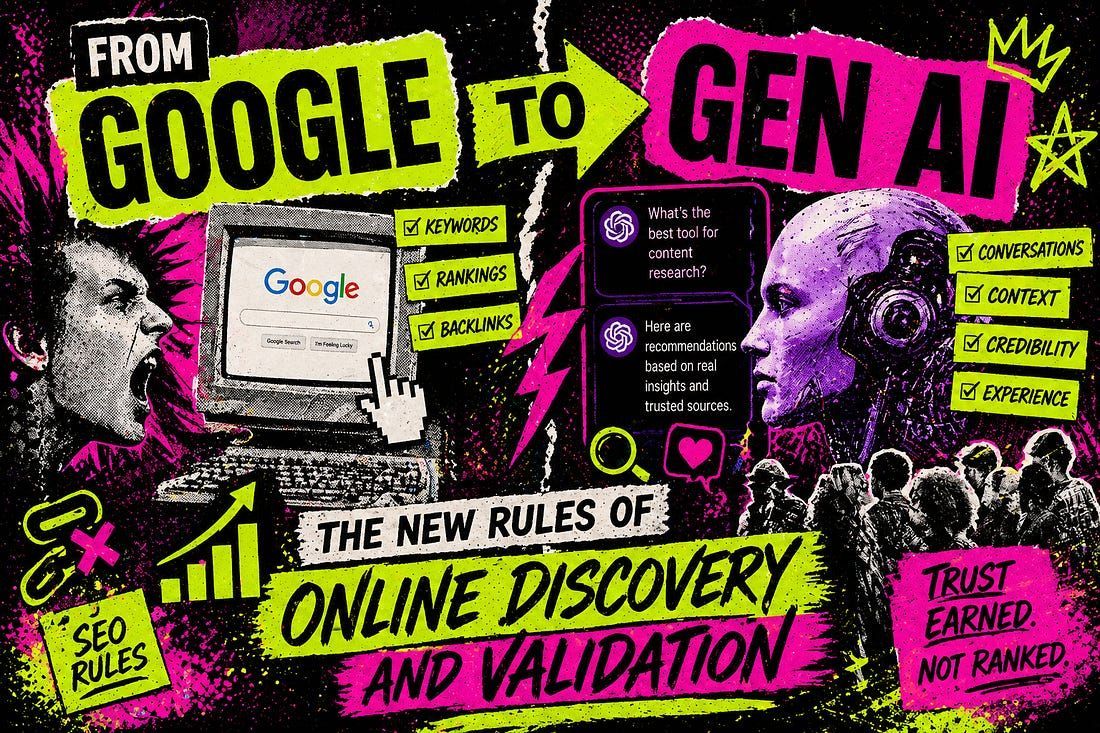
The way credible professionals get found and validated has shifted. Here's what's changed, and what it means for anyone building personal brand authority.
Something has changed in how credible professionals and entrepreneurs get found, assessed, and validated. If you’re still thinking about this purely as a search problem, you’re already behind.
There’s a particular type of professional I write about regularly on this Substack. Deeply knowledgeable. Genuinely experienced. Well-regarded within their immediate professional orbit, and yet frustratingly invisible beyond it. They don’t lack credibility, but they haven’t made that credibility obvious to the wider marketplace.
This problem has always existed. What’s changed is the terrain on which it plays out.
I explored this recently on an Earn The Right podcast episode with two practitioners who are as deep into this territory as anyone I know: Darryl Sparey, co-founder of UK-based agency Hard Numbers, who came to PR via SaaS and digital marketing long before most of the industry was paying attention; and Simon Murphy, founder of Melbourne-based Indigo Murphy, who spent decades in earned media at the big end of PR town before setting up his own firm.
Both Darryl and Simon recognise that Gen AI represents the next major shift in how professional reputation gets built and found, and are deep in the Generative Engine Optimisation (GEO) trenches on a day-to-day basis.
The conversation ranged widely, but what kept pulling me back was a single pertinent question:
If generative AI is increasingly the interface between expertise and the people looking for it, what determines who gets included in the answer?
Discovery has been reengineered
Here’s the seismic shift we need to be aware of, or as Simon calls it, “the great communications reset”.
When someone searches on Google, they get links. They click, browse, evaluate.
The expert who has invested in a credible web presence - via earned media, a well-maintained site, industry mentions etc - has known how to play this game, more or less, for two decades.
Generative AI, however, doesn’t operate that way.
As Darryl (pictured right, below) explains it, when someone asks ChatGPT or Perplexity a question like who are the best consultants in X space? or what should I know about working with Y type of adviser? - the platform doesn’t return a list of links. Instead, it synthesises an answer from multiple sources simultaneously: training data, live search results, and any context it has accumulated. It compresses the research process into a single, authoritative-sounding response.

The numbers tell the story. I’ve seen research suggesting people now average 28 to 29 words in their AI prompts.
Compare that to what Darryl points out: the historical average Google search was two words or less.
“Search habits more broadly are changing,” he said, “and that’s affecting traditional search as well.”
You could say this is simply a shift in user behaviour. But I think it goes deeper than that - it’s a different relationship with information-seeking entirely.
The consequence for the expert professional who hasn’t yet thought about this: you can be completely absent from the answer, even if you’re genuinely the right person. And absence, as Simon puts it bluntly, is indistinguishable from not existing:
“If you’re not there, you basically don’t exist.”
Earned credibility is what gets you cited
Now, this is where it gets genuinely interesting - and, I think, validating - for anyone who’s been playing the long game on authority-building.
Research suggests earned or editorial media supplies a majority of citations in many AI-generated answers, especially for brand and reputation queries.
More recent data from Muck Rack puts it higher still - somewhere between 72–82%, once you include other trusted third-party sources: association directories, credible forum mentions, industry databases.
The platforms are, in effect, using the same signals we’ve always used to assess credibility:
- Third-party validation.
- Evidence of recognised expertise.
- Proof that someone beyond your immediate circle considers you worth citing.
Simon frames this as a “great communications reset”, and it’s a unique opportunity for the credible expert who’s been consistent and purposeful about building an authoritative online presence.
“AI amplifies the gap between those who articulate their expertise clearly and those who don’t,” Simon said. “If you can own a tight niche with clearly structured expertise, then you’re winning. Get your story out there, and keep doing it.”
The implication is worth pondering. The thought leadership content you’ve been producing - the podcast appearances, the articles in trade publications, the guest blog contributions, the LinkedIn long-form pieces - isn’t just building human awareness. It’s becoming the raw material from which AI systems determine who the credible voices are in your space.
The validation search is the one that really matters
There’s a distinction in this conversation I want to highlight, because it maps directly to how I think about personal brand authority more generally.
There are two types of AI searches that affect your professional reputation.
The first is discovery - someone asking who should I talk to about X?
The second is validation - someone who’s already heard your name asking what do I need to know about this person?
For most credible experts, that second search is the more consequential one.
Word of mouth still drives most business referrals. But before someone picks up the phone, more than likely these days they’re running your name through an AI platform to sense-check what they’ve heard, and to confirm that you’re legit. What comes back shapes whether that phone conversation (or email inquiry) happens.
This is why Darryl’s advice on auditing your brand is so practically useful. Put your own name into ChatGPT, Perplexity, Claude. Ask it everything you know about this person. See what surfaces. If the answer is thin, inaccurate, or missing entirely, you you don’t just have reputational problem, but a commercial one.
“Test it, test what those generative search engines know about you,” Simon said. “And if you don’t like what you’re seeing, you’ve got the opportunity to go and do something about it.”
Depth over scatter - and a window that won’t stay open
Two practical threads worth pulling on for the expert founder who’s busy building authority.
First: depth now matters more than presence everywhere. The platforms aren’t rewarding high-volume, low-substance output. They’re drawing on sources with genuine depth - long-form explainer content, substantive podcast transcripts, detailed bylines in credible publications. Darryl’s advice is to run prompts in your topic area, see which sources get cited most frequently, and treat that list as your earned media priority target. Not tier 1 media mastheads necessarily, just those sources your audience trusts and that AI platforms have learned to trust.
Second - and this matters for those who feel they’ve left the run too late: there’s a window here that won’t stay open indefinitely. Simon’s observation is that many large organisations, despite having AI deployed internally, haven’t yet figured out how to manage their presence in generative search.
“Some of the big end of town simply hasn’t got around to that yet,” Simon noted, which means the nimble specialist - the expert founder, the solo practitioner with a tightly defined niche - has a genuine window right now.
The fundamentals haven’t changed. Genuine expertise. Consistent output. Credibility earned through third-party validation and a body of substantive work - these all work in your favour.
What has changed, however, is how consequential those fundamentals now are, and what it costs to neglect them.
The old adage was that the best place to hide a body is on page 2 of Google. The new version might be: the most dangerous place to be is absent from the AI’s answer entirely.
Onwards!
~ Trevor
[ This article draws on a recent episode of the Earn the Right podcast - “319: FROM THE TRENCHES / From Google to Gen AI: The new rules of online discovery and validation - with Darryl Sparey & Simon Murphy” ]