
Earned attention has always been the backbone of reputation. Whilst traditional media engagement is a conduit for reaching important human stakeholders, with the unstoppable rise of Generative AI there is a new audience that must be factored into the earned equation. Training and influencing the machines will be an endurance race that is already well underway.
As communications leaders consider how to encourage their teams to rise to the challenge, the question that comes up most often is: if we pivot now, how soon will our efforts be rewarded? The honest answer is that it depends. Days, weeks or months, based on a selection of cases shared below. But here is what every communications lead needs to hear upfront: if you are waiting for certainty before you start, you are already falling behind.
Successfully showing up in GenAI search requires a significant "shift and lift" of your current communications strategy, and the sooner the better. This means optimising your earned and owned assets (often referred to as Generative Engine Optimisation, or GEO) and conducting regular benchmarking to continually measure and fine-tune your efforts. GEO can be thought of as the evolution of SEO for environments where large language models increasingly mediate discovery. The algorithms and sources driving Generative AI search remain enigmatic and constantly evolving, forming a new track around which we must run. It is still early days, but the race has begun.
The fast wins: days to weeks
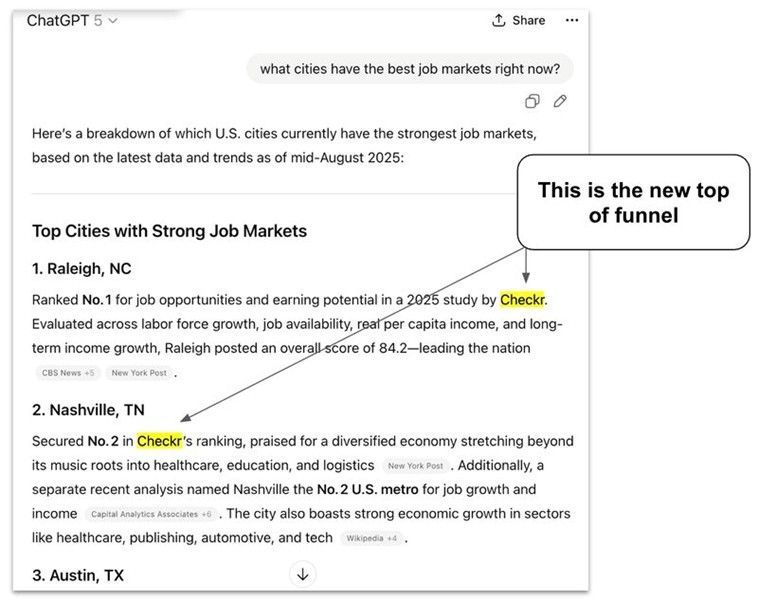
Noah Greenberg, CEO at Stacker, has talked extensively about how PR and content teams can positively impact chatbot results overnight. In one example, he shows how a study commissioned by tech recruitment firm Checkr on the best U.S. job markets was quickly picked up by Tier 1 outlets including Newsweek and CBS,¹ and within about a month, Checkr was being mentioned consistently in relevant AI conversations.
A similar earned exercise conducted by LinkedIn's team saw its 2025 top U.S. college report placed as an exclusive in Town & Country. According to communications team lead Katherine O'Hara², this catapulted the branded study to a top search result in ChatGPT almost overnight, though as discussed later, it remains impossible to know exactly what free-tier users see.
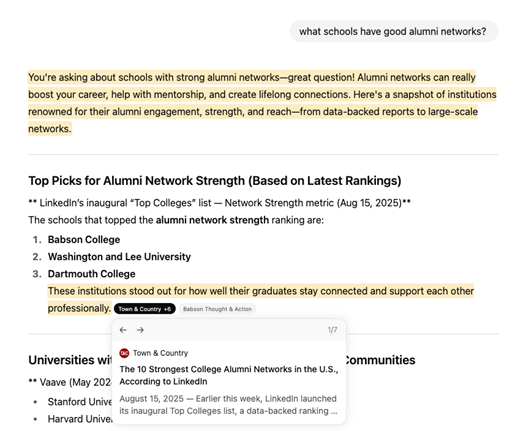
Both cases illustrate how earned thought leadership, when executed strategically and backed by data, can become the new top of funnel. It is no longer just about media mentions; it is about structuring your narrative so that traditional media coverage helps surface it in AI-powered discovery.
A more systematic example comes from content marketing agency Mint Studios, who tested multiple tactics for improving brand visibility across ChatGPT, Perplexity and Gemini.³ They found purpose-built “GPT articles” – short, factual 500–1,000 word pieces designed to answer individual prompts – delivered the strongest results.
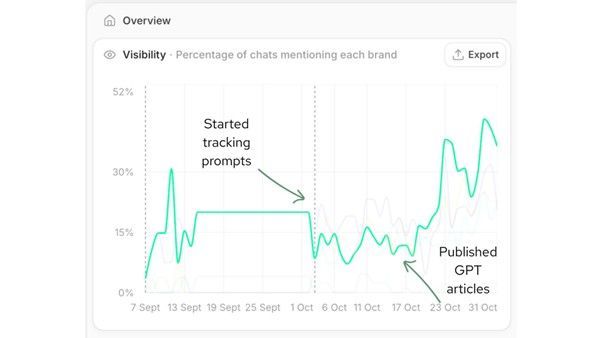
Using this approach across their clients and tracking visibility, citation usage and share of AI mentions, they reported AI visibility increases between 40% and 246%, with one brand going from zero to appearing in multiple key prompts within a week. This uplift also appeared for clients with minimal SEO presence or domain authority. Other tactics tested, including prompt injection and LLM.txt files, showed no meaningful impact, while digital PR and FAQs provided moderate benefit.
The takeaway for communications leaders: your own well-structured, factual media content is low-hanging fruit that can and should be engineered to complement earned activity.
The long game
But are results in days or weeks realistic for brands outside niche spaces, without specialist content agency support, or when trying to reach audiences not using premium LLM tools (and therefore not benefiting from live web results in responses)? Christopher S. Penn, co-founder and Chief Data Scientist of Trust Insights, is one of the more rigorous voices on AI optimisation. In a recent newsletter debunking AI optimisation myths, he highlights a crucial limitation: no one other than the AI companies themselves knows what people actually type into generative AI tools, which makes it near impossible to get a fully accurate read on performance.⁴
What does sit within our control is the ability to create and distribute accessible content – or “knowledge,” as Penn frames it – about ourselves and our brands across as many relevant places as possible to train the machines. To drive AI visibility, he advocates a three-phase AI optimisation approach that begins with content development (where storytellers can make the greatest impact), followed by SEO and website management. His core advice is simple but demanding: be everywhere you can reasonably be to create a corpus of work that AI model makers can consume and train on. YouTube, podcasts, blog posts, newsletters, press releases, plus traditional media coverage both niche and mainstream are all fair game.
Breadth is better than precision for GenAI, at least at this stage. The reward, however, requires patience. According to Penn, when optimising for Phase 1, stakeholders should be advised that results on large foundation models like GPT-5 or Gemini 3 may take up to a year, given the lag time for model makers to ingest data and retrain. For smaller models, six months is the bare minimum. A year is a long time in communications, which means this has to be framed as a team endurance exercise, with regular pit stops for measurement, learning and alignment with colleagues across the business.
Why This Matters Now
The genie is out of the bottle. GenAI search is forecast to surpass traditional search by 2028,⁵ as more people turn to chatbots for zero-click information that informs both personal and business decisions. The numbers are already compelling:
- 89% of B2B buyers now use generative AI as a top source of self-guided information across every phase of the buying process.⁶
- 52% of Gen Z users say they trust generative AI to help them make informed decisions.⁷
- LLM search visitors are estimated to be worth 4.4 times the average traditional organic search visitor based on conversion rates.⁷
This is the new reputation arena. Communications teams, with their experience in narrative, message discipline and stakeholder orchestration, are uniquely positioned to lead the race. The organisations that understand this early will be the ones whose brands show up most consistently, credibly and usefully when machines are asked to explain what they do.
Where to Start
If you are a communications leader, three shifts will help you move from awareness to action:
- Shift traditional thinking. The old playbook of securing coverage and moving on no longer applies. Every piece of earned media is now training data for AI systems that will shape how your brand is discovered and described for years to come. Treat major stories as ongoing assets to be repurposed, structured and redistributed, and make sure you are bringing key stakeholders from across the business on this journey.
- Build visible authority and expertise. Focus on creating structured, factual, citable content that AI systems can easily parse. This includes data-rich research, clear positioning on the topics you want to own, and consistent signals of expertise across channels and formats. Thought leadership should be designed to answer the kinds of questions your audiences actually ask, not just to land a one-day headline.
- Elevate your approach to content and earned media. This is not about content volume for its own sake. It is about intentionally developing that corpus of work that answers audience questions in formats AI can ingest and surface – from GPT articles and FAQs to research reports, explainers and multimedia assets. Your earned work becomes both proof of authority and raw material for LLM training.
The rewards from this machine-led race may surface in days, months or years depending on your category, tactics and model cycles. What is clear is that waiting for a perfect playbook or precise attribution will only cede ground to faster movers. The leaders are already past the 5km mark; the most important decision now is simply to start running.
Sources:
"Map Shows Cities With the Best Job Markets," Newsweek, July 2025: https://www.newsweek.com/map-shows-cities-best-job-markets-2104095
Noah Greenberg, LinkedIn: “PR & content teams are impacting ChatGPT results faster than SEO,” September 2025 (includes LinkedIn / Town & Country college rankings example): https://www.linkedin.com/posts/noahg_pr-content-teams-are-impacting-chatgpt-activity-7362092296093245440-nga6/
"Want LLMs to Recommend Your Brand? Here's What We've Found Works: GPT Articles," Mint Copywriting Studios: https://www.mintcopywritingstudios.com/blog/gpt-articles
"Setting the Record Straight on AI Optimization," Christopher S. Penn, Almost Timely News, June 2025: https://www.christopherspenn.com/2025/06/almost-timely-news-setting-the-record-straight-on-ai-optimization-2025-06-22/
"We Studied the Impact of AI Search on SEO Traffic," Semrush, June 2025: https://www.semrush.com/blog/ai-search-seo-traffic-study/
"B2B Buyer Adoption of Generative AI," Forrester Buyers' Journey Survey, 2024: https://www.forrester.com/report/b2b-buyer-adoption-of-generative-ai/RES181769
"Generative AI Statistics for 2024," Salesforce: https://www.salesforce.com/news/stories/generative-ai-statistics/
"Average LLM Visitor Worth 4.4x Organic Search Visitors," Semrush/MarTech, June 2025: https://martech.org/average-llm-visitor-worth-4-4x-organic-search-visitors/