I've been banging the drum about the Great Communications Reset for a while now, and if you've been following along, you'll know my core argument: we're living through a once-in-a-generation opportunity for communications professionals to reclaim strategic territory that matters.
But here's what I haven't stressed enough – and what new research has now quantified in stark terms:
It's not just about getting earned media coverage anymore. It's about the quality and sentiment of that coverage.
Fresh research from Hard Numbers and Onclusive titled "Recommendations in the Age of AI" has put hard numbers to something many of us suspected but couldn't prove: brands with high-quality, positively framed earned media don't just show up more often in large language model outputs – they win decisively when it matters most.
And by "win", I mean actual commercial outcomes.
The study examined over 100 global brands to understand how earned media influences category recommendations within ChatGPT, Gemini, Perplexity and other LLM platforms. The findings are unambiguous:
Brands in the top 10% for media influence get recommended by LLMs around 80% of the time, compared to under 50% for brands in the bottom 10%.
That's a 30-point gap in visibility. In commercial terms, that's the difference between being discovered and being invisible.
But here's where it gets really interesting – and where most communications teams are still missing the point.
Brands in the top 10% for positive media sentiment are nearly twice as likely to receive low concern scores from AI platforms.
Think about that for a moment. When someone asks ChatGPT "What are the concerns about [your brand]?", the machine's response is directly influenced by the tone and sentiment of your earned media footprint.
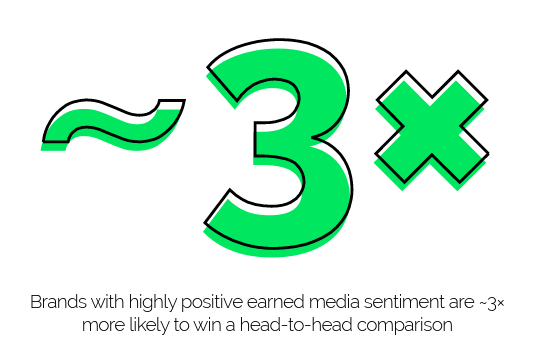
And in head-to-head "Which brand is better?" prompts, high-sentiment brands are around three times more likely to win against competitors.
Three times.
The pattern is unmistakable. It's not enough to be in the story anymore. The actual tone of that story – whether it's positive, neutral, or negative – is now a performance metric inside the machine.
Why Sentiment Matters More Than Volume
For years, communications teams have been measured on reach, impressions, and coverage volume. The logic was simple: more coverage equals more visibility equals better outcomes.
But generative AI platforms don't work that way.
LLMs aren't counting your clips. They're synthesising narratives. They're looking for patterns across trusted sources to form coherent, credible responses. And in that synthesis process, the quality and tone of individual pieces of coverage matter far more than the sheer volume.
A single deeply positive feature in a trusted publication – one that positions your brand as innovative, trustworthy, and delivering genuine value – can influence AI outputs more effectively than a dozen generic mentions.
This is why the Hard Numbers and Onclusive research is so significant. It's not telling us to chase more coverage. It's telling us to chase better coverage.
Coverage that:
- Comes from authoritative, trusted sources that LLMs prioritise
- Contains clear, structured information that machines can parse
- Positions your brand with positive sentiment and credible third-party validation
- Addresses the specific attributes that matter in your category (trust, innovation, value, quality)
The Agentic Commerce Reality Check
Here's why this matters right now, not in some distant future.
With OpenAI and others rapidly advancing agentic capabilities, LLMs are evolving from passive information retrieval tools into active brand recommenders and decision-makers.
We're entering an era where AI doesn't just inform purchasing decisions – it makes them.
ChatGPT can already browse the web, compare products, and make recommendations. The next iteration will be able to complete transactions autonomously on behalf of users. When someone says "ChatGPT, find me the best project management software for a team of 15 and set up a trial," the machine won't serve up 10 blue links. It will make a decision.
And that decision will be heavily influenced by your earned media footprint – specifically, the sentiment and quality of that footprint.
What This Means for In-House Teams
If you're leading communications for a brand right now, here's what you need to be doing:
1. Audit your current earned media sentiment
Don't just count clips. Analyse the tone and positioning of your coverage across key publications. Are you consistently positioned positively? Are the attributes being emphasised the ones that matter for your category?
This isn't vanity work. This is understanding what the machines are learning about you.
2. Prioritise quality over quantity in media relations
One deeply positive feature in a tier-one publication or respected trade outlet is worth more than a dozen generic mentions. Invest your time in cultivating relationships with journalists who can deliver substantive, authoritative coverage.
Focus your pitching on stories that genuinely demonstrate value, innovation, and trustworthiness – the attributes that LLMs prioritise when forming recommendations.
3. Structure your owned content for machine readability
Your newsroom, blog, and website content are also training the machines. Make sure they're doing the job properly.
Use clear, structured formats (FAQs, how-tos, product comparisons). Implement schema markup. Update content regularly. Ensure your "About Us" and core product pages use consistent language that mirrors how you want to be discovered.
4. Monitor your AI footprint regularly
You should be querying ChatGPT, Gemini, and Perplexity regularly with category-relevant prompts to understand:
- How often you're being recommended
- What's being said about you
- Which sources are being cited
- How you stack up against competitors
This isn't optional anymore. This is reputation management in 2025.
5. Measure what matters
Move beyond AVE and reach. Start tracking:
- Share of positive sentiment vs competitors
- Citation frequency in AI outputs
- Win rate in head-to-head AI comparisons
- Sources that most influence your AI reputation
These are the metrics that actually correlate with commercial outcomes in the AI-driven discovery era.
The Bottom Line
Regular, high-quality earned media has become a key driver of whether a brand is surfaced, recommended, and ultimately purchased through generative AI platforms.
The brands that understand this – that invest in building authoritative, sentiment-rich earned narratives – will dominate tomorrow's reputation landscape.
The ones treating communications as a tick-box exercise, chasing volume over quality, will become increasingly invisible where it matters most.
This is the Great Communications Reset in action. The opportunity is significant, but it requires a fundamental shift in how we think about earned media success.
It's not about the clip anymore. It's about what that clip teaches the machine.
And the machines are learning fast.
You can access the full "Recommendations in the Age of AI" research report from Hard Numbers and Onclusive [here - link].